During the infamous Scopes Monkey Trial, prosecutor William Jennings Bryan dismissed the idea of human evolution because it suggested humans descended “not even from American monkeys, but from old world monkeys.” Likewise, in the notorious 1860 Oxford debate on evolution between Thomas Henry Huxley and Bishop Samuel Wilberforce, Wilberforce smugly questioned Huxley as to whether he would prefer to have a monkey as his grandmother or as his grandfather.
For Bryan and Wilberforce, the incredulity of having a monkey as an ancestor was enough to quickly dismiss any thought of human evolution. In fact, many who reject evolution on religious grounds feel they can end a discussion on the topic with the quip, “So you believe we descended from monkeys?,” a question for which they think there is no respectable response.
Of course, humans did not descend directly from old world monkeys. While they do share a common ancestor, these lineages diverged roughly 25 million years ago. Rather than descending directly from monkeys, humans emerged relatively recently, approximately 200-300,000 years ago, from a particularly advanced hominin group. Yet, even that connection, in which humans directly descend from highly advanced hominins, is still beyond the pale for many Christians.
Such a scenario seems to be beneath the dignity of mankind. To think that we emerged in some fashion from non-rational animals, no matter how advanced they may have been, seems to conflict with the belief that humans are made in the image and likeness of God. It seems difficult to reconcile our divine destiny with the evolutionary belief that we emerged in some fashion from mere animals.
The Dust of the Earth
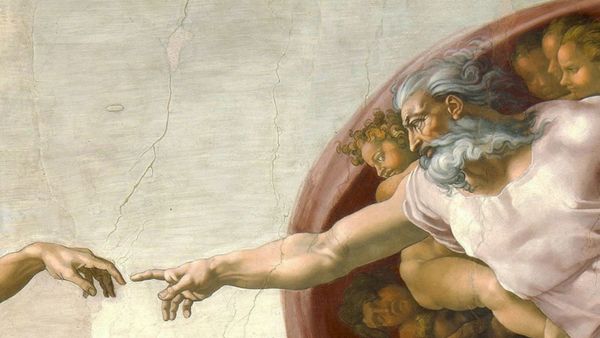
The plain reading of the Biblical text suggests that the physical matter of man was not created ex nihilo. Instead, man is brought forth out of the dust or dirt of the ground. (The Hebrew word “afar” is used here and has been translated to mean dust, dirt, and earth at various places in the Old Testament.) But man is not simply a material being, a creature made solely out of the dust of the earth. Man is a single substance composed of both body and soul. He is a unity of the dust of the earth, a body, informed by the breath of God, a soul. This immaterial soul, which informs the matter, is created ex nihilo by God and cannot be reduced to the outcome of an evolutionary process.
Given the immaterial aspects of the human person, any material explanation of man cannot be complete. Likewise, because man is made of a particular type of matter, any solely spiritual explanation of man is also incomplete. As the Catechism points out, “spirit and matter, in man, are not two natures united, but rather their union forms a single nature.”[1] Man cannot be fully explained by either just body or just soul; each is in some manner dependent upon the other for its existence. Yet this unity in man of spirit and matter creates a discontinuity in nature. As John Paul II pointed out, compared to other earthly creatures, “with man, we find ourselves facing a different ontological order—an ontological leap, we could say.”[2] This ontological leap was the creation ex nihilo of a human soul, which informed the “afar” and brought about the “single nature” of man. This is the deep discontinuity that exists on the metaphysical level between man and other earthly creatures.
Despite this discontinuity at the metaphysical level, there exists a physical continuity between humans and other animals. It is a physical continuity at which even the Genesis text is hinting. The dirt or dust of which we are composed is the same dirt and dust of which bacteria, plants, and animals are composed. There is little to no difference between the material components, the carbon metabolism, or the physiology of an advanced hominin and a human. Clearly, we share a continuity on the physical level with other organisms; the question is the source of this physical continuity.
In the second creation account, the Biblical text indicates that matter for the first man was taken from the dust of the earth, the “afar.” Recognizing the symbolic nature of the text, one does not need to hold that God took physical dust and mud and somehow shaped it into a human person with the aid of the immaterial soul. Rather, the “afar” points to the fact that we come from the earth. Just as the first Genesis creation account indicates that the earth will “produce living creatures” and “produce vegetation,” the dust or earth that makes up humans is no different. As Genesis 3:19 states, “Remember that you are dust and to dust you will return.” We have a material aspect that we derive from the created world in a manner similar to other creatures, and this matter will decay back into the earth upon our death.
When a new human normally comes into being, the requisite physical matter is contributed by the egg and sperm of the human parents. When these gametes fuse, they undergo a substantial change such that the resultant new entity, the zygote, is the type of thing that is fitting to be informed by an immaterial human soul. This soul, which is called forth by the matter, is created ex nihilo by God at the very first moment of our existence. However, the emergence of the first humans could not have occurred in this manner given the conspicuous absence of human parents to contribute the requisite matter.
The well-known Genesis 2 creation account avoids this problem by positing that the material cause for the first human is the dust (afar) of the earth. However, we know from experience that the dust of the earth is not the type of thing that is fitting to receive a rational soul. Humans do not normally spring up from the dust of the earth, as this is not the requisite matter for humans. Dirt or mud on its own does not have the fittingness to be informed by a human soul. Certainly, God could have supernaturally transformed dirt into matter that had such fittingness, but dirt certainly would not possess the necessary potential on its own. However, the notion that God arbitrarily transformed the dirt of the earth into the matter requisite for the formation of the first human runs counter to how God normally acts in the natural world. God, as the cause of all causes, normally allows natural causes to produce that which is fitting for them to produce. In the words of the Jesuit theologian Francisco Suarez, “God does not interfere directly with the natural order where secondary causes suffice to produce the intended effect.”[3] Given the strong evidence for common descent, it is more in line with our experience of God’s action that he would allow natural processes to produce the matter fitting for our first parents rather than overriding natural causal processes.
Given our ever-deepening knowledge of natural evolutionary processes, it seems appropriate to see the use of the word “afar” as pointing to the fact that humans are materially derived from the earth, not that humans were directly transformed from dirt. The reality is that from the perspective of a Catholic understanding of man, it makes little difference if the matter that composed the first man was derived from dirt or if it was provided by advanced hominins. So long as one recognizes that man cannot be reduced to matter alone, that he is a unity of body and spirit, there seems to be no theological necessity for choosing one option over the other. In addition, acknowledging that the physical matter necessary for the first humans came from advanced hominins does no violence to our Catholic understanding of what man is (a unity of body and soul made in the Imago Dei). However, such an understanding is consistent with the overwhelming evidence that exists for common descent. But if this scenario is correct, how then did the first man emerge from the hominin family tree? How exactly was the matter prepared such that it could be fitting to be informed by a human soul?
The Body Creates the Soul and the Soul Creates the Body
From both a biological and theological perspective, there is a lot about the exact origins of humans that we do not fully understand. Unfortunately, much of the biological details may remain forever hidden behind the veil of history. Despite this, from a theological perspective, we do know that man did not emerge gradually. As St. John Paul II makes clear, there is “an ontological leap” that separates man from other creatures. As such, there must be a jump from an advanced hominin to a creature informed by a rational soul, one made to be in relationship with God. There is no half man/half hominin. You are either the type of thing fitting to be informed by a rational soul or you are not.
To make this leap, one possibility that has been put forth is that God could have used an adult advanced hominin, transforming the hominin into a human person via the creation of a human soul. However, such a scenario has problems on a philosophical level. As the Dominican Mariusz Tabaczek points out, this “suggests a very unusual case of substantial change of an already existing [hominin] into a different living being . . . without considerable changes in its physical dispositions (the soul of a hominin is ‘replaced’ by the soul of the first representative of Homo sapiens.)”[4]
This would suggest that the infusion of the soul is voluntaristic in that God arbitrarily decides whether that specific substance receives a hominin or human soul. But the soul is not some arbitrary add-on that can be swapped in and out like a transmission. The matter and the soul that compose a single substance are intimately related. According to the Theologian Matthew Ramage, “the human soul and body are so closely united that whatever was new about the first truly human soul was inevitably accompanied by something new (i.e. genetic change [or epigenetic change] in the body of the first human person.”[5] This unity of body and soul is so intimate that Ratzinger claims both inform each other:
Not only does the soul create the body, the body also creates the soul. Only when the soul becomes the soul of this body does it truly become a “human” soul. The body does not suffice as an unica causa for the spirit, but neither can the soul be brought forth without the body. The soul does not come from the body, but with the body. The formula “God creates the individual soul” is imprecise and needs to be supplemented.[6]
The human soul is created by God through the reality of the biological matter of a human zygote. In other words, the secondary matter predisposed to be informed by the soul of an advanced hominin would not be of the type of matter fitting to be informed by an immaterial human soul.
To escape from this dilemma, one could propose that God supernaturally transformed the matter of the hominin such that it would then be fitting to receive an immaterial human soul. This would be similar to the miraculous material transformation that would have to occur if God took dirt and produced the first human. (Of course, there would be less transformation needed with the matter provided by an advanced hominin than with the matter provided by the dirt.) While this is logically possible, it still does not remove the arbitrariness of the whole enterprise, as God would be seen as picking one hominin to transform materially even though there would be no substantial difference between that advanced hominin and any other. In addition, this scenario would be “rather foreign to the Thomistic understanding of divine action [in which] God’s agency takes into account the nature of things and works through them as secondary and instrumental causes.”[7] God normally allows natural causes to produce that which is fitting for them to produce, rather than overriding the natural causal processes. For example, if natural evolutionary processes can transform matter naturally over time to produce material fitting to be informed by a hominin soul, what warrant would one have to think that natural processes could not also have predisposed matter to the point that it would be fitting for it to be informed by a human soul.
Rather than postulating some type of arbitrary supernatural transformation of matter at the dawn of our existence, a transformation that exempts us from the evolutionary process, it seems more fitting that the first human would, like all of us, have been informed by an immaterial human soul from the first moment of conception. Due to a novel “particular natural condition,” this novel zygote would be the type of entity fitting to be informed by a human soul from the very first moment of its existence. The novel “particular natural condition” would be a combination of specific genetic, protein, and RNA alterations, transmitted through the sperm and oocyte, to the first human zygote. Seen in this fashion, the natural processes of evolution would produce the properly disposed matter in the biological form of a novel product of conception that would be immediately informed by an immaterial human soul. This transformed biological matter would not produce the human soul—the soul is created ex nihilo by God—but it would give reality to that soul. Such a scenario gives new depth to the understanding that humans are the crown or summit of creation. God’s creation would produce that which God destined it produce from all eternity, a creature fittingly structured to know and love him.
Pope Benedict captures this reality with his typical clarity and insight:
The picture that describes the origin of Adam is valid for each human being in the same way. Each human is Adam, a new beginning; Adam is each human being. The physiological event is more than a physiological event. Each human is more than a new combination of information; the origin of each human being is a creation. Its wonder is that it happens not next to but rather precisely in the processes of a living being and its invariant reproduction.[8]
The Womb of a Creature
The idea that the first humans were indeed human from the very first moment of conception implies that the first humans must have been conceived in and emerged from the womb of an advanced hominin. At first glance this seems repulsive. How could a human be reduced to having hominin parents? How could they, mere hominins, bring forth a human person. This seems so preposterous and scandalous that many would agree with the Catholic anti-evolutionist Ernesto Cardinal Ruffini’s opinion when he stated: “Who will be ready to believe that Adam had for his father and mother two brute beasts? Although innocent and holy, he would certainly have been in a much less honorable condition than is ours.”[9]
Yet the notion that the first humans emerged in this fashion is no more scandalous than the claim that the Word of God become flesh, subjecting himself to becoming a zygote in the womb of a mere creature. Of course Mary is the holiest of creatures, but she is a creature nonetheless. In fact, as one contemplates human origins, one’s reflections on the matter could only benefit from viewing it through the lens of the two conceptions that lie at the heart of Salvation history, the Incarnation and the Immaculate Conception.
In terms of the Incarnation, it seems incredulous to many that the God of the universe would lower himself to incarnate in the womb of a mere creature. But that is exactly what Christ did. According to von Balthasar, “God becomes ‘nothing,’ so that the ‘nothings’ might become God.”[10] The Uncreated God of the universe took on human flesh and entered the womb of Mary to become man. Given this reality, it would be hard to argue that humans emerging from the womb of advanced hominins is more scandalous or shocking than the teaching that God entered, developed, and emerged from the womb of Mary.
In fact, there seems to be a fittingness between the emergence of humans in the womb of a hominin and both the Incarnation and the Immaculate Conception. Both the Incarnation, the New Adam, and the Immaculate Conception, the New Eve, recapitulate and fulfill the Old Testament typology of our first parents. Adam is seen as a “type” of Christ, whose sin is redeemed in the New Testament by the “New Adam.” Likewise, Mary is referred to as the “New Eve” as her fiat allows redemption to enter the world in the form of Christ, unlike the old Eve whose rejection of God brought disorder. In this manner, the New Testament types always transcend and fulfill the Old Testament types.
But it is not merely that the Old Testament types point to their fulfillment in the New. The New Testament fulfillment also illuminates our proper understanding of the Old Testament types. The New Adam shines light on how we should understand Adam. Thus, the manner by which Christ entered the world should shed light on the emergence of the old Adam. Commenting on Irenaeus’ understanding of this recapitulation of types, Hans Urs von Balthasar states the following: “What [Irenaeus] means is this: the second Adam is the repetition, in divine truth, of the first Adam, the Adam who turned away from God. The second Adam repeats the whole natural development of man at the higher level of divine reality.”[11]
Here then, Christ’s “whole natural development” should inform our understanding of Adam’s natural development as Christ’s development is recapitulating Adam’s. Viewed in this fashion, the Incarnation of Christ, the true Man, in the womb of Mary, a mere creature, repeats “at the higher level of divine reality” Adam becoming incarnate in the womb of a non-rational creature. If it was not beneath Christ to enter our humanity in the womb of Mary, it could hardly be beneath our first parents to emerge from his creation in the womb of a hominin. Is it more fitting to emerge from the dust? Would not the first Adam, the Old Testament type of Christ, have reflected the same pattern as Christ, albeit on a lower level, as he enters the world in the womb as a zygote. In fact, rather than seeing man’s emergence from hominins as some “less honorable condition,” one could see it as exceptionally fitting given that it points toward the most miraculous and transformative event of Salvation history, the emergence of the True Man in the person of Christ in the womb of a mere creature.
Likewise, Mary as the new Eve, immaculately conceived in the womb of a sinful human, can inform our understanding of the emergence of the first woman. In the case of Eve, God is able, working with the novel matter provided by the created world, to bring the first woman into existence through the creation of a human soul. This action is then recapitulated at a higher level in Mary, the new Eve. In the case of Mary, God is able, working with the matter provided by Anne and Joachim, to bring Mary into existence through the creation of a human soul and the undoing of the effects of sin on Mary. Just as the Incarnation both reflects and goes beyond the creation of Adam, the Immaculate Conception both incorporates and transcends the creation of Eve. The Immaculate Conception is an act that recapitulates the creation of Eve but at a “higher level of divine reality.” Seen in this manner, the emergence of our first parents in the womb of hominins repeats the whole natural development of these two central events of our Faith.
Redeeming All of Our Humanity
While the account of human origins in Genesis 2 indicates that the first man was drawn from the “afar,” the matter of the earth, he originates in the text as a fully formed adult. Christ on the other hand did not enter the world in this manner. It was certainly in his power to appear on earth as a fully formed thirty-year-old adult, but it is rather instructive that he did not enter the created world in such a disruptive manner. The fact that he entered the world, as all men do, in the womb as a zygote, is one manner by which he fully took on our humanity, entering into every stage of human development in order to redeem every aspect of it on the Cross. He made his entrance into the world radically dependent on the very creatures he sustained in existence. For nine months in the womb, and then through infancy and childhood, he was dependent on Mary and Joseph for his sustenance and safety.
Once again it seems fitting that our first parents would have entered the world in an analogous manner. Just like Christ and Mary, the first humans would not have entered creation fully formed, disruptive intruders into the Created order much like foreign interlopers. Rather, like both Christ and Mary, they would emerge from it in a manner that does no violence to the natural order of things but rather transcends it. The first humans, like Christ, would have entered and participated in every stage of human development. In doing so, the first humans would have been dependent upon other creatures for their physical survival just as Christ made himself dependent upon Mary and Joseph. Such a scenario would repeat not only the whole natural development of Christ and Mary on a lower level, but it would also repeat our own natural development. The first humans would emerge in the created order in the same manner as any other human, as a vulnerable zygote. They would be radically dependent on other creatures for their existence and would experience the full range of human development. Like Christ, who recapitulates this in the Incarnation, they would be deeply embedded and dependent upon this world, but they would be oriented beyond it.
In this sense, the emergence of humans from advanced hominins foreshadows both our emergence from human parents and Christ’s incarnation. As the theologian Fr. Roch Kereszty points out:
God’s continuous creation in this context means that he enabled . . . our hominin ancestors to engender a being (or beings) whose level of being transcended theirs. In human conception this same “miracle” happens every time a man and woman become parents of a new human person. In the process of generation, God’s creative intervention allows the parents to transcend themselves.[12]
It is important to note that this “miraculous” intervention is not something that is evident at the level of the biology. The biological components of the sperm and oocyte that gave rise to the first human would have been transformed via natural processes to enable hominins to produce the type of zygote that was fitting to be informed by a rational soul. One does not have to posit a miraculous transformation of the material or matter. The natural order of things would proceed with its own God-given integrity through the accumulation of genetic and epigenetic changes to produce what nature has the powers to produce. In this manner, the emergence of man would have been prepared by God working through his creation, rather than God having to insert himself over and above it.
Just as God worked through Anne and Joachim, natural biological creatures, to prepare for the Immaculate Conception, God worked through created causes to prepare the natural biological material necessary for the emergence of the first humans. Of course, this does not imply that the Immaculate Conception can be reduced to the biological. It simply means that the biological material that composed Mary at the zygote stage was provided by creatures, while the gift of being conceived without original sin was provided supernaturally by God. Likewise, the natural evolutionary process, over billions of years, produced the biological material that composed our first parents at the zygote stage, matter which, in his plan, “called forth” to God for the creation ex nihilo of an immortal human soul.
One Minor Objection
One difficulty that is perceived from this view of human emergence is the fact that hominin parents would have lacked the rational ability to provide our first humans with the experiences needed for human language acquisition and human cognitive development. In the case of human language, this is a capacity that humans naturally acquire without much effort, provided they are exposed to normal human speech throughout early development. Yet our first parents would not have had the luxury of being exposed to normal human speech and would therefore lack the proper natural environment for acquiring it.
On account of this fact, it might seem necessary to argue that humans were created as fully formed adults complete with all adult capabilities including human language. However, if humans emerged as fully formed as described in Genesis, the language acquisition process would have been short circuited such that the first humans would have no memory of acquiring this knowledge, they would simply possess it. In fact, they would have no memories of anything regarding their past experiences simply because they would have none. Such a scenario, which reflects neither our human experience nor that of Christ, seems difficult to reconcile with our direct human experience of the self. Our memories and past experiences are such a core part of our identity, it is difficult to imagine what it would actually mean to be an adult human yet have no prior history of oneself. This is not the human condition. Presumably Christ, who fully entered our humanity, went through the normal language acquisition process just as all humans before him, learning from Mary and Joseph his native tongue. Likewise, his past experiences and memories would have formed his human personality and contributed to his sense of self in a manner similar to all other humans. Does it not seem more fitting that our first parents would have experienced a similar development?
Yet, how then might one resolve the apparent dilemma regarding language acquisition and cognitive development given their lack of human parents? While any suggestion is speculative, we do know from Catholic teaching that our first parents were blessed with the preternatural gifts including infused knowledge and understanding. Armed in such a fashion, it seems feasible that they would have been able to acquire language and develop human cognitive skills in a manner proper to their developmental stage in ways we do not fully understand. Given the nascent biological structures, they likely did not have full infused knowledge from the moment of conception. Rather, it seems more fitting that they would have acquired infused knowledge gradually such that they possessed it at the appropriate developmental stages. For instance, in the case of human speech, the infused knowledge would have progressed through babbling and repetition of sound (which hominins likely did) to the association of sounds with objects in their world (something that it is also likely that hominins did) and then eventually to the association of words with concepts and the ability to arrange them in a structured syntax.
In fact, this is similar to the manner by which Irenaeus thought our first parents developed. Although he believed man was created fully formed, he held that man was created in a naïve developmental stage that made him still in need of further enlightenment by his maker. This naïve state that man occupied explains for Irenaeus why our first parents succumbed to temptation. “Man was a young child, not yet having a perfect deliberation, and because of this he was easily deceived by the seducer.”[13] Just as Irenaeus posited man was created in a state requiring further physical, spiritual, and mental development, the same caveat would apply to humans emerging as zygotes in the womb of an advanced hominin. In the latter case, God, through the granting of the preternatural gifts, could have infused the knowledge needed for language and fully developed conceptual thinking in a manner that respected normal human development.
The First Adam
When examining human origins from a Catholic perspective, it seems only natural to begin with a focus on Adam and Eve and the description in Genesis of the Garden of Eden. The problem with this starting point is that it gets the focus of the inquiry exactly reversed. We should look at human origins not through the lens of the first man mentioned in the Bible, but rather through the true first man, Christ. As Conor Cunningham puts it,
Christ is the true Adam, which is to say, just as John the Baptist must decrease that Christ may increase, so also the first Adam is “decreased” to the degree that he does not even make any sense, except in light of [Christ]. Put differently, the end reigns over the beginning because Christ, not Adam, is the true beginning.[14]
As such, any attempt to understand human origins should begin with contemplating the real first human, Christ. As the Orthodox theologian Peter Bouteneff stated, “rather than Adam being a model or image for humanity or even the first real human being, it is Christ who is both. Christ is the first true human being, and Christ is the image of God and the model of Adam.”[15] Adam makes sense only in and through Christ, who as “the Lamb slain before the foundation of the world” (Rev 13:8) comes prior to Adam.
Christ’s incarnation is scandalous from a human perspective, but that scandal allows us to see the truth in everything else. As Irenaeus grasped, Christ recapitulated “in himself the whole of the human race from the beginning to the end.”[16] It is Christ who makes sense of all that occurs in the created order because Christ is prior to it. Humans were not created perfect in some Edenic garden long before Christ, who only enters the drama at a later stage. Rather, we were called forth from the created world in a state of journeying toward our ultimate perfection in Christ, the Savior who is, was, and always will be. We can only find our meaning and destiny in him, the true first Man. Therefore, it seems fitting that just as the Father called Christ forth from the womb of a creature, a most scandalous affair, this should recapitulate in some sense how the Father called us forth at the dawn of humanity from the womb of the created order.
When human origins are viewed in and through Christ (and Mary), what at first seems like a forced attempt at patching together incongruous theological and scientific truths becomes profoundly typological. Not only does the conflict fade but the evolutionary origin of man seems quite fitting, particularly given the connection between our first parents and the New Adam and the New Eve. Instead of compromising the Faith or putting the believer on the defensive, this view of human evolution does something quite different. It brings into focus the typological fulfillment, the recapitulation of human emergence, that exists in the true human origins story, the story of the Incarnation and the Immaculate Conception.
[1] CCC, 365.
[2] Pope John Paul II, Message to the Pontifical Academy of Sciences: On Evolution, 22 October 1996.
[3] Erich Wasmann, “Evolution,” in The Catholic Encyclopedia, Vol. V (New York: The Gilmary Society, 1909), 654.
[4] M. Tabaczek, (2023) Contemporary version of the monogenetic model of anthropogenesis—Some critical remarks from the Thomistic perspective. Religions 14: 528.
[5] M. Ramage (2022) From the Dust of the Earth: Benedict XVI, The Bible, and The Theory of Evolution (Washington, DC: CUA Press), 183.
[6] Ratzinger (1958), Schöpfungslehre, 76.
[7] M. Tabaczek (2024) Theistic Evolution: A Contemporary Aristotelian-Thomistic Perspective (Cambridge: Cambridge University Press), 260.
[8] Ratzinger (1989) Man between reproduction and creation: Theological questions on the origin of human life" Internationale Katholische Zeitschrift, 68.
[9] E. Ruffini, (1948) La Teoria dell’evoluzione secondo la scienza e la fede (Norcia: Orbis Catholicus), trans. Francis O’Hanlon, in The Theory of Evolution Judged by Reason and Faith (New York: Wagner, 1959), 139.
[10] Hans Van Balthasar (1981) The Scandal of the Incarnation: Irenaeus Against the Heresies, trans. John Saward, (San Francisco: Ignatius Press) 53.
[11] Ibid, p. 53.
[12] Roch Kereszty (2002) Jesus Christ: Fundamentals of Christology (New York: Alba House), 70.
[13] Irenaeus, On the Apostolic Preaching 12, trans. John Behr (Crestwood, NY: St. Vladimir’s Seminary Press, 1997), 47.
[14] Conor Cunningham, (2010) Darwin’s Pious Idea: Why the Ultra-Darwinists and Creationists Both Get It Wrong (Grand Rapids, MI: Eerdmans), 393.
[15] Peter Bouteneff, (2008) Beginnings: Ancient Christian Readings of the Biblical Creation Narratives (Grand Rapids, MI: Baker Academic), 45.
[16] Ireneaus, Against Heresies 5.23.2.