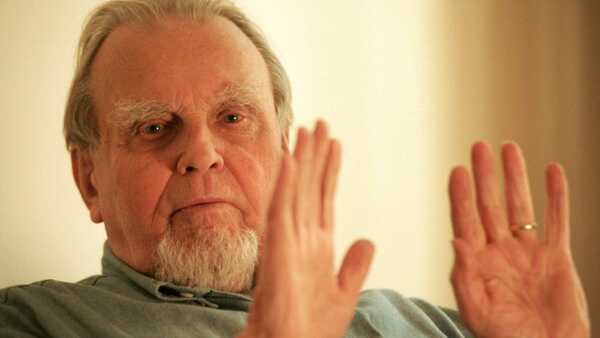
In 1945, as the Nazi oppression of Poland ended, Czeslaw Milosz returned to Warsaw. There he published Ocalenie (Salvation or Rescue), the collection of his wartime poetry in which he first learned to speak, like Mickiewicz before him, with a clear prophetic voice. The audacity of his claims for the public role of poetry in this book was epitomized by the challenging question in Przedmowa (“Foreword” or “Dedication”), the first poem in the collection, albeit the last to be written:
What is poetry that does not save (ocalić)
Nations or people?
A connivance with official lies. (NCP, 77)
Perhaps such a daring question could only be credibly asked in a country like Poland, which had survived its suppression as a state for two centuries, thanks to its shared faith and culture.
At critical moments in his life, Milosz would return to this question of “ocalenie.” This question is asked in the very first line of his mid-length 1947 Treatise on Morals. It is returned to in the two companion Treatises, Treatise on Poetry (1956) and Treatise on Theology (2001), as a basso ostinato underling his entire poetic career. I wish to show that, in the slow process of achieving the saving poetry of which he wrote, a pivotal moment was recorded in his poem To Albert Einstein, finished in 1950, the tormented year leading up to his defection.
Milosz strove repeatedly to connect two antithetical artistic cravings: the spectatorial and the activist. As spectators, he wrote,
Artists crave being (bytu), a communication with the divine promise within creation. For them, processions of armies, social struggles, the chaos of dying regimes and emergent political systems simply happen on the outside. For others, those battles and that chaos are reality itself. As for me, whatever I accomplished that was worthwhile was due precisely to the clash of these two attitudes within myself (NR, 294).
A little earlier, Milosz had already described his own inner doubleness, in which these competing views of reality (here labeled “being” and “movement” [“that is, in history” (TP, 121)]) vied for dominance, as he struggled to establish a correct balance between the two.[1]
He traced this conflict back to the conflict during his Catholic schoolyears between his Jesuit teacher of theology and his humanist teacher of history. Later, when he read Thomas Mann’s parable The Magic Mountain at the university, he identified his inner pair as Naphta and Settembrini (NR, 71).[2]
Both Ocalenie and the Treatise on Poetry make carefully considered arguments for the same correct balance: an engagement with history from the perspective of pure being outside history. Ocalenie’s opening lines in “Foreword” were addressed to a poet who perished in the doomed Warsaw Uprising of 1944 without that perspective, having confused “blind force with accomplished shape” (NCP, 77).[3]
In my book Ecstatic Pessimist I devote a third of its fifteen chapters to the book’s carefully composed transition from the perspective of seeing as a spectator “on the outside,” (on the model of Eliot’s Waste Land and its persona of “I, Tiresias”) to the measured engagement with history in the late poems of the book’s frame.
The transition is epitomized within the pastoral sequence “The World (Naïve Poems)” at the book’s center. Even within the mini-sequence of Faith, Hope, Love at “The World’s” center, we see a process, from a flat secular world impervious to dreams (“Faith”) to a more spiritual perspective increasingly vertical, on that diminished world, beyond our senses and understanding (“Love”).
“The World” is flanked, before and after, by Milosz’s two seminal poems about the Warsaw Ghetto Uprising of 1942, “Campo dei Fiori,” and “A Poor Christian Looks at the Ghetto.” The first, once again, is from the earthly perspective of an unaffected observer, focused on secular and sensuous details (the drowning of a bright carnival melody by gunfire from the ghetto wall). In the second, the agony is not of others but of the observer himself, suffering pangs of guilt and fear within the enlarged contexts of both time (“the great book of the species”) and what Milosz repeatedly called “the objective Reality situated beyond our senses.”[4]
Ocalenie closed optimistically with an appeal to poets in general to restore the happiness without which the “world will perish” (NCP, 76). Two years later, in the first of what would ultimately be three Treatises, Traktat moralny (1947), Milosz answered a critic’s question, “Where is the ocalenie?” with a much more chastened answer:
Let us pass from hand to hand
The common gift of modest wisdom.
As you see, I do not have a prescription,
I do not belong to any sect,
And the rescue (ocalenie) is in you alone.
Perhaps it is simply health
Of mind, a balanced heart . . .
Let us go in peace, we simple people.
I need to say this with some starkness:
Before us lies
“The Heart of Darkness.”[5]
By way of contrast, Milosz’s second treatise, the Treatise on Poetry (Traktat poetycki, 1957), is “a poetry of commitment” (TP, 124) to engage personally with history:
. . . poetry, philosophy, action were not
For us, separated, as they were for them[6]
But joined in one will: we needed to be of use.
And that is the – sometimes burdensome – recompense (TP, 60).
Asked years later about the poem, Milosz commented, “In some measure, Treatise on Poetry is proof that philosophy, poetry, and action can be united.”[7]
Later still, in Notes to the Treatise, Milosz situated its commitment in the context of the dilemma he had described earlier in Native Realm, between “poetry as contemplation of being (bytu) or poetry as participation in movement (ruchu), that is, in history, and thus a poetry of commitment” (TP, 121).
What occasioned this difficult transition in his poetry, from celebrant of happiness to commitment to be a personal agent of change? We find an answer in the important poem of 1948-49 “for the drawer” (i.e., not for publication), “To Albert Einstein (fragments).” This poem, excluded by Milosz from his first postwar collection of 1953, was not published until four decades later. Yet the manuscript of the poem, where the available space for writing is defined by dozens of carefully drawn little doodles, suggests that Milosz put many hours into its painful composition.
Here is the poem, as recently translated into English by Robert Hass and David Frick:
“To Albert Einstein (fragments)”
In a blue tricot shirt and with the face
Of a clockmaker from the Jewish neighborhood in Warsaw,
With a pipe and a white mane, smiling sadly,
Allow me, gracious old man, to offer you a poem.[8]
To use poetry in such a fashion brings me joy.
The need to adore is strong. A girl
Hangs a picture of her favorite movie star on the wall.
For me, I admit, life would not have essence
If I were not able to admire. I hide in my heart
Unspoken words constantly. I regret being so little able
To help people value the great beauty of the world.
Everything interested me. The names of trees and plants,
The rise of species, Darwin’s journeys,
Polynesian myths, the mating dress of birds,
Half-obliterated sculptures in forgotten lands.
The microscopes in cold laboratories enticed me,
I learned several languages, wishing to read
About the fifth century in Rome, Greece, Alexandria,
And about the sixteenth century in maritime Europe,
Critical epochs, and similar to mine which arose for me,
A child, in the ashes of the first World War,
The thunder of cannons, the bellowing of cattle
Driven on roads over which our refugee cart
Was driven in the dust. If I turn to you today,
It is not only because, forged from (kute w, carved in)
marble,
Your bust stands where Newton and Copernicus
Stand in our memory. Not that you succeeded
In placing an equal sign between gravity
And electricity. There is something greater in you:
Faith in the light of reason, invincible concern
For our human species, for what it can be
And also for what it can, despicably, squander.
Not the cold of a neutral explorer of Nature,
But the warmth, the anxiety of genuine goodness.
I’m ashamed to speak it out loud. The matter
That it is so difficult to name, the matter of hope,
Chafes. I have seen people transformed into beasts
Or locked in the prison house of learned illusions.
I am writing this in the capital of the United States.
It’s summer, the birds are making a racket along the avenues.
Bright-colored cars speed by. People on the greens
Play ball, play golf, grill hotdogs on the fire grates
In the park. The radios on the motorcycles
Bleat about spies, about fugitive criminals,
War, Communists, and about new weapons.
This New Jerusalem of old Puritans,
Their dream fulfilled, though in reverse,
Is for me an oppressive, empty stage set
As when asleep I want to scream and can’t (a krzyknąć nie mogę).I have, however, learned to say no. This is
A privilege long ago granted to us poets,
That wages, weddings, baptisms, and burials
Are not our true theme. They are no more
Than glitter, a flight of reflections
On huge black waters. As though through a glass garden
We walk, and see with sorrow more than is permitted.
With regret, more than is allowed.
Are we really enemies of the species,
Yearning to change by force people into angels
Of pure intellect? To tear out of the depths a spark
That hated spark for which Prometheus was tortured.
Washington D.C., 1948-49[9]
(As we shall see, Milosz himself translated the last line literally, as “A hated spark of Promethean torture.” The difference is significant.)
When the poem was first published in Polish, very belatedly in 1993, the editors at Znak Publishers arbitrarily assigned it the date 1948. (The same date was accepted by Milosz in his own partial translation of 1997.)[10] In 2005, the editors at Znak corrected the date of composition to 1948-1949, noting that “a signed manuscript [of the poem] is explicitly undersigned 1949.”[11] This is indeed the probable date for the first fragment. But the date for the second, I shall argue, is almost certainly 1950, the year in which Milosz later said he spoke frankly with Einstein about his problem of whether or not to return from Washington (“‘What to do?’ had grown into a tormenting nightmare, day and night,” YH, 121).
There are only two “fragments” to this poem. But the turn between them, defined by the adverbial “however,” spans the gap between the anguished last line of the first (“As if I wished to cry out in my sleep, and can’t”), in torment, and the rejoinder opening the second (“I have, however, learned to say no”), in partial resolution.
The two fragments, in other words, frame Milosz’s pivotal decision to break with the Warsaw regime and defect publicly in Paris in May 1950, in the office of the CIA-funded journal Preuves. At this time, he published a statement explaining his belated decision to denounce the Stalinist regime in Warsaw, for which he chose the simple title “No” (Nie).[12]
In 1948 the Stalinist PZPR Party took over the postwar Polish coalition government, and started to enforce socialist realism as the obligatory style for contemporary Polish literature. Milosz visited Poland briefly to assess the new situation, and found “the whole country . . . bursting with hatred for its rulers and their Russian employers” (NR, 280). He thereupon “decided to break with the communist regime.”[13] But to defect to America (as his wife Janka wished him to do) was out of the question for him. His existence as a poet depended on the Polish culture that was, like himself, both older and more cosmopolitan than the brief interwar Polish Republic. In addition, as he later recalled, he was too profoundly alienated by American culture (YH, 122).[14]
Then a solution presented itself to his dilemma, of how to break with the post-war Polish government and still maintain his vital connection with the Polish language. In November 1949, two Paris-based exiles from the Preuves circle met at least twice with him in Washington. These were Jerży Giedroyc, editor of the Polish anti-communist journal Kultura, and his friend Jozef Czapski (the latter possibly accompanied on the second visit by his CIA mentor, James Burnham). The two Poles offered him the “escape route” he would ultimately accept in 1951, of defecting in Paris and becoming engaged there in the current cultural Cold War.[15]
Initially, according to Ewa Kołodziejczyk, Milosz, when asked by Giedroyc to collaborate, “did not avail himself of this opportunity.”[16] Yet within weeks the offer may have inspired Milosz’s only poem from this era with a date in its title, “For Myself in a Diary for the New Year 1950.” The poem is evidence that Milosz was now tempted by the offer from Czapski and Burnham to become personally engaged in historical action. It clearly voices the poet’s powerless obsession to be heard, as voiced also in the first fragment of “To Albert Einstein,”
If only I could do something. I have nothing but this pen.
Even for a skilled hand it’s a treacherous weapon.
People will not hear me out, Nature will extinguish me.
It also voices (in response to the ancient call of poetry) the manic persona Milosz confesses to be in the second, “yearning to change people by force into angels” with “a hated spark of Promethean torture”:[17]
For Myself in a Diary for the New Year 1950.
I hear a voice. I don’t know where it comes from
or to what it summons me . . .
But if I disdain this hidden strength?
It is a lie that has befallen all poets . . .
When you are already in Hell, be the devil who pushes
Into the cauldron the sweet little soul squealing mawkishly . . .
Is it better to be the devil than the sweet soul? You bet (Pewnie).[18]
This poem reads like a precursor to the decision to act (like Einstein) in the second “fragment” of “To Albert Einstein.” The poet, as if in a New Year’s resolution, has now decided that it is better to speak out dangerously than to be silent. But he has not yet settled on what he will say (i.e., make a clean break with the post-war Polish state for which he was still working).
It could even be that by writing the first “fragment” Milosz contemplated his enforced muteness, and recognized that he must correct it. His silence was a feature above all of his status as a diplomat. But this was precisely when his U.S. post was ending; and he was obsessed with the decision whether or not to defect and start a new life. But to defect would prolong indefinitely his separation from his Polish-speaking audience behind the Iron Curtain, a second and deeper reason why any cries from him could not be heard.
Underlying the mood of impotence in the first “fragment,” and Promethean empowerment in the second, was this central dilemma of whether, and how, he should defect. In 1950, by all accounts, he was still perplexed by this decision, on which he sought counsel from two colleagues who were also exiles in America.
The first was the celebrated poet-diplomat Saint-John Perse (born Alexis Léger), who during the war had been briefly stripped of his job and his citizenship by the French Vichy government.[19] The second and more important consultation (“probably in the summer of 1950”)[20] was his friend Albert Einstein, whom he had first consulted in 1948 on another matter.[21]
The contrasting moods of the two fragments is firmly delineated by the change in his attitude toward Einstein. In the first he places Einstein (as a “you”) on a pedestal as a role model.
If I turn to you today,
It is not only because, forged from marble,
Your bust stands where Newton and Copernicus
Stand in our memory. Not that you succeeded
In placing an equal sign between gravity
And electricity.[22] There is something greater in you:
Faith in the light of reason, invincible concern
For our human species, for what it can be
And also for what it can, despicably, squander.
Not the cold of a neutral explorer of Nature,
But the warmth, the anxiety of genuine goodness.
In the second fragment, Milosz speaks in a prophetic voice (albeit tinged with moral ambivalence) reminiscent of his pivotal wartime poem “Flight”:
Are we in fact the enemies of the species,
Who wish to change human beings by force
Into angels of pure intellect, to tear from the depths
A hated spark of Promethean torture?[23]
The persona’s acquisition of purpose is illustrated also by the “fragments’” changes in his use of poetry, as part of his overall mental focus. At the outset of the first “fragment,” his role for poetry is celebratory rather than generative:
Allow me, gracious old man, to offer you a poem.
To use poetry in such a fashion brings me joy.
The need to adore is strong. A girl
Hangs a picture of her favorite movie star on the wall.
For me, I admit, life would not have essence
If I were not able to admire.
But at the outset of the second “fragment,” he has become aware of an older mission for poetry, a “privilege afforded to poets,” one in which “wages, weddings, baptisms, and funerals / Are not matter for us.” In place of spectatorial celebration, Milosz now simultaneously acknowledges and questions his own activist “wish to change human beings by force.” Milosz’s inner Naphta, for whom the chaos of history is reality, has taken over in the second fragment from his inner Settembrini, the humanist spectator.
In this way, Milosz’s poem “To Albert Einstein” is his first poem explicitly to entertain the role for himself of historical engagement, the “unpolitical politics” (NR, 247) of his poetry as salvation, the role which he will soon explicitly embrace and defend in the Treatise on Poetry.
Not just his attitude towards poetry changes between the two fragments; his entire mentality does. His indulgence in admiration is expanded on in the first “fragment,” when he still hides in his heart “unspoken words constantly”:
Everything interested me. The names of trees and plants,
The rise of species, Darwin’s journeys,
Polynesian myths, the mating dress of birds,
Half-obliterated sculptures in forgotten lands.
The microscopes in cold laboratories enticed me,
I learned several languages, wishing to read
About the fifth century in Rome, Greece, Alexandria.
This is indeed a very accurate description of the “spectator” aspect of Milosz’s double nature, one which would dominate again later in his historically unambitious American poetry. It is also an aspect that would be ruthlessly criticized in The Captive Mind (1953) by Milosz the activist. There it is condemned as “escapism,” or “Aesthetic Ketman” (the practice of escaping from an alienating present by focusing on the exotic or the past):
Aesthetic Ketman . . . is expressed in that unconscious longing for strangeness which is channeled toward controlled amusements like theater, film, and folk festivals, but also into various forms of escapism . . . Many choose university careers because research into literary history offers a safe pretext for plunging into the past and for converse with works of great aesthetic value.[24]
It is clear that in the second “fragment” the voice of Milosz’s internal spectator has been replaced by Milosz’s internal activist. And the moral risks of this Promethean impulse, to change humans with a “hated spark,” is expressed in language that implies a changed attitude towards Einstein, who had changed human history, very problematically, with his letter to FDR advocating development of an atom bomb.[25]
In Native Realm, Milosz writes that this change occurred the moment he heard Einstein advise him, “You had better stick to your country”:
Despite all my veneration for him, a little ironical imp in me tore him from the pedestal that people had erected to this successor of Newton, and I saw him as one of many, part of a certain generation of Europeans. He was a humanitarian [convinced] that man is a reasonable creature . . . But for my generation man was already the plaything of demonic powers born not in himself but in an interhuman space created by both him and his fellow-man. So I walked out of the little house on Mercer Street . . . a stranger to my own body [realizing] that we have to rely only on ourselves (NR, 282-83).[26]
This is even more clear in Milosz’s own translation in Year of the Hunter (1987):
We walk, and we see with sorrow more than is
permitted
Are we really enemies of the species
Yearning to change by force people into angels
Of pure intellect? To tear out of the depths a spark,
A hated spark of Promethean torture? (“To Albert Einstein, 1948,” translated by the author)The fanatic Naphta from The Magic Mountain makes his
bow. Now [i.e., in 1987] I am trying pronounce judgment as
objectively as possible, and it certainly does not come easy (YH, 122).
Milosz in 1949-1950 sees himself as assuming a historical role. But Milosz by 1987 has experienced both influence and fame; and he now quotes the end of his poem about himself (omitting all he had written about Einstein), not prospectively but retrospectively, in the context of what he calls there a descent “deep into one’s shame” (YH, 120).
Shame was the theme also of “Bypassing Rue Descartes” (1980). There, recollections of visiting Paris (the scene of his defection in 1951) led to condemnations, first of those who learned in Paris “to kill in the name of the universal, beautiful ideas,” and then his own “heavy sins,” as when he once
pushed a rock down onto a water snake . . .
And what I have met with in life was the just punishment
Which reaches, sooner or later, the breaker of a taboo (NCP, 393-94).[27]
To fully understand the meaning of “To Albert Einstein,” we must recall controversies leading up to its central decision “to say no,” both in the 1940s and again in the 1980s. Some of these were disagreements with his former poet allies back in Poland, but a deeper conflict haunted Milosz from inside his own divided doubleness, his internal Naphta and Settembrini.
To begin with, Milosz’s decision to make a “clean break” and defect earned him enemies on all sides, including the French intelligentsia.
To those who were building a socialist Poland he remained a traitor. This animosity towards Milosz always lingered. It was overshadowed by the Nobel Prize, but returned in the 1990s when the poet became engaged in the public debate in Poland.[28]
Prominent among his Polish attackers was his former close friend and colleague Zbigniew Herbert, who now derided Milosz as “a naïve leftist who dreamt of changing the world, a delusion that leads to totalitarianism in his mind.” Franaszek argues that Year of the Hunter was motivated in part as a response to this critique of him, noting that it described Herbert and his teacher Henryk Elzenberg as representing “a typical metaphysical Polish movement, where the highest absolute was not God but the homeland.” [29]
Year of the Hunter was published as it was written, serially, in the form of dated journal entries from 1987-88. In it he confessed that his recent fame from the Nobel Prize and return to Poland was not the acme of his life it should have been, “because I was preoccupied with and protected by completely different problems, very private, very personal” (YH, 139).
It is very clear that in the entry where he felt shame from having written “To Albert Einstein” (as the product of his “fanatic Naphta”) the controversy he now regretted was less the one with his former friends in Poland, than the disagreement over the defection with his wife Janka, then in a difficult pregnancy with their second son Peter.
One day earlier, in Year of the Hunter, Milosz had written:
America almost destroyed the loving closeness between us that had weathered years of war. After Tony was born, . . . we argued repeatedly, mainly about America. She was an intelligent and loving person, and not the woman who had to deal with a husband afflicted with philosophical madness, although my case was a particularly drastic one. (YH, 120)
Janka, astutely, never challenged Milosz on the defection issue itself.[30] But he knew very well, not just that Janka’s strong preference was for him to defect in America, but that her physician had advised that her pregnancy was so delicate she should not travel.[31]
This was Milosz’s dilemma, whether to give priority to his love for Janka or to his poetic needs.[32] In 1988, he would see this dilemma in the perspective of “the central fact of my life story: Janka’s and my marriage” (YH, 196-97). But years earlier, he had located the ultimate source of the dilemma inside himself, when he referred in passing to “my abandonment of my wife and children [in Washington] for the sake of a literary career [in Paris].”[33]
This ultimate egoism underlay the “heavy sins” Milosz wrote of in 1980 in “Bypassing Rue Descartes.” Renata Gorczyńska, who was with Milosz in Paris in 1980, supplied a biographical explanation for the young Milosz’s sense of guilt in 1934-35. It was that Milosz, by accepting the chance to visit the supposed “capital of the world” on a scholarship, had abandoned in Wilno his lover Jadwiga Waszkiewicz, just when he had gotten her pregnant.[34]
But his abandonment of an early lover could not have affected Milosz as acutely as his abandonment in 1950 of his pregnant wife, which, as he implicitly acknowledged, permanently scarred his happy early marriage. (“A true marriage is heaven on earth. That is what I sought and that is what, but only briefly, I experienced with Janka,” YH, 216).
Milosz was so afflicted with remorse over this difficult choice that in January 1951, only two weeks before his defection, he wrote to Janka, regretting his decision bitterly.[35] Yet when the two were reunited thirty-three months later, Milosz wrote another crucial poem, “Notebook; Banks of Leman,” renewing his vow to seek “an eternal moment” from “movement” (i.e. history), and not from “being.”[36]
In Part 4 of the Treatise on Poetry, Milosz attempted to justify his “sometimes burdensome” decision “to be of use” in history (TP, 60), warning that to choose the opposite—Nature “and the rose . . . Symbol of love and superterrestrial beauty”—“will open a chasm deeper than your knowledge” (TP, 55).[37]
But this language in 1957 suggests that Milosz had still not fully resolved his ambivalence about the defection that was evident in the self-questioning at the close of “To Albert Einstein.”
Are we really enemies of the species
Yearning to change by force people into angels
Of pure intellect? To tear out of the depths a spark,
A hated spark of Promethean torture?
Two years later, in Native Realm, he questioned his commitment to change history even more sharply.
Who knows if it was not precisely this impossibility of bringing order to my personal problems that caused me to nourish myself so passionately for several years on catastrophic visions, borrowing from the Marxists little more than their belief in a spasm of history? (NR, 172-73).
His return to America and “Nature” in 1960 inaugurated two decades of outwardly calm and successful dedication to poetry.
But internally, on the eve of winning international awards, he had sunk deeper into his mood of self-recrimination.
Forgive [literally, “Get away from”] me, dark spirit.
Don’t say that you are the truth of my being
And that my whole life was only about concealing evil.[38]
By now he had an additional reason to regret his abandonment of Janka in 1950: the acute mental illness of his son Peter who had been born from that difficult pregnancy. In 1979 he wrote to his former confessor in France, Father Józef Sadzik, “confessing to the priest about his repeated supplication in his prayers for the restoration of Piotr’s [Peter’s] sanity in exchange for the honor of the Nobel Prize.”[39]
We really do not see a closure to the difficult dilemma raised by Milosz’s Promethean ambitions until his return to Poland in the 1990s. There he composed a more decisive closure to his dilemma with a confession in the last of his three Treatises, the Treatise on Theology (2002).
The frame of this Treatise (like that of the three Treatises taken together) is a Hegelian triad: it narrates how his initial identity with the faith of simple people was broken by his move away to the city and urban culture, but ultimately restored by his voluntary return to common people and their faith.
In the middle phase of this Treatise (the Hegelian antithesis) Milosz confesses once again the “veiled evil” consequences of his poetic dedication.
I feel in myself so much veiled evil
That I do not exclude myself from the possibility of
hell.It would probably be the hell of artists.
I.e. people who valued the perfection of their oeuvre
Over their duties as husbands, fathers, brothers,
citizens (SS, 61).[40]
The Treatise ends with an address to the “Beautiful lady” who “appeared to the children at Lourdes” (where he himself had been a pilgrim), as if “to remind them that beauty is one of the components of the world” (SS, 64). In a very late poem, Milosz asked again, “Wasn’t it always our greatest wish / to live and dwell for ages in brightness?”[41]
Charles Taylor quotes this last fragment to illustrate how poetry can fulfil “the human need for cosmic connection . . . not just any mode of awareness of the surrounding world, but one shot through with joy, significance, inspiration.”[42]
Abbreviations:
ABC: Czeslaw Milosz. Milosz's ABC’s. New York: Farrar, Straus and Giroux, 2001.
LU: Czeslaw Milosz. The Land of Ulro. New York: Farrar, Straus, and Giroux, 1984.
NCP: Czeslaw Milosz. New and Collected Poems: 1931-2001. New York: Ecco Press/ HarperCollins, 2003.
NR: Czeslaw Milosz. Native Realm: A Search for Self-Definition. New York: Farrar, Straus and Giroux, 1968
SLP: Czeslaw Milosz, Selected and Last Poems, 1931-2004. New York: Harper Collins, 2011.
SS: Czeslaw Milosz. Second Space: New Poems. New York: Ecco, 2004.
TP: Czeslaw Milosz. A Treatise on Poetry. New York: Ecco Press/ HarperCollins, 2001.
WP: Czeslaw Milosz. The Witness of Poetry. Cambridge, MA: Harvard UP, 1983.
YH: Czeslaw Milosz. A Year of the Hunter. New York: Noonday Press, Farrar, Straus and Giroux, 1995.
[1] NR, 275: “Whoever commits himself to movement alone will destroy himself. Whoever disregards movement will also destroy himself, but in a different way. This, I said to myself, is the very core of my destiny.” (Abbreviations like NR are explained in an Appendix at the end of this essay.)
[2] Cf. Peter Dale Scott, Ecstatic Pessimist: Czeslaw Milosz, Poet of Catastrophe and Hope (Lanham, MD: Rowman & Littlefield, 2023), 33. There I suggest that the last crucial line of “Love,” Nie ten najlepiej sluży, kto rozumie, should be translated as “He does not serve the best, who understands.”
[3] Cf. discussion in Scott, Ecstatic Pessimist, 97-100.
[4] WP, 66; discussion in Scott, Ecstatic Pessimist, 73-76.
[5] Czesław Miłosz, translated by Robert Hass and David Frick, Miłosz in the New World: Poems 1946-53 (New York: Ecco, 2025), 49.
[6] The Young Poland poets before World War I at the beginning of the Treatise on Poetry (TP, 123).
[7] Ewa Czarnecka and Aleksanderf Fiut, Conversations with Czeslaw Milosz (New York: Harcourt Brace Jovanovich, 1981), 191. Asked to whom the “we” referred, Milosz answered: perhaps himself and his close friend Julius Kroński.
[8] In Native Realm, Milosz recalls “Einstein’s white mane, his gray sweatshirt . . . everything about him appealed to my father complex, my yearning for a protector and leader” (NR, 282).
[9] Czesław Miłosz, Wiersze (Kraków: Znak. 2002), Vol.2, 147-48; Miłosz, Miłosz in the New World, 68-69. Frick’s original translation of this last line was “That hated spark for which Prometheus was tortured.” I wrote this essay and copied Frick’s translation from a pre-publication bound proof of Poet in the New world. After I shared this essay with Bob Hass, he corrected the published volume to reflect Milosz’s own literal translation, which I use here. Cf. below after fn. 27.
[10] Miłosz, Wiersze Vol. 2, 411. Kołodziejczyk claims, mistakenly, that “To Albert Einstein” . . . was published . . . only after Miłosz’s death, in 2008” (Eva Kołodziejczyk, Czesław Miłosz in Postwar America [Warsaw: De Gruyter Open Poland, 2021], 257).
[11] Miłosz, Wiersze, Vol. 2, 411.
[12] Kultura 5 (May 1950); Franaszek, Milosz: A Biography, 285-87; Scott, Ecstatic Pessimist. 125-27.
[13] “The Captive Mind revisited: Jerzy Krzyżanowski on Czeslaw Milosz,” The Free Library.
[14] Another factor was the imperial politics of those “who want to rule the world” and “live by the knife and the submachine gun.” Czeslaw Milosz, “Central Park,” Wiersze, Vol. 2, 49-50. For a long tome Milosz reproved both America and Britain for the handing over of Poland to Stalin at Yalta (Scott, Ecstatic Pessimist, 117, 129).
[15] Andrzej Franaszek, Miłosz: Biografia (Kraków: Znak, 2021, 480); Scott, Ecstatic Pessimist, 125-26.
[16] Kołodziejczyk, Czesław Miłosz in Postwar America, 39; cf. 96: “Czapski, announcing his arrival in Washington. D.C., refers to an earlier conversation with Miłosz and finds him to be introverted. The letter implies the meeting with Miłosz did not pass easily.” See the letter of Józef Czapski to Czesław Miłosz of April 30, 1950, Beinecke Library, Box 1, Folder 15.
[17] Frick’s original translation of this last line was “That hated spark for which Prometheus was tortured.” See discussion below.
[18] Miłosz, Miłosz in Washington, 97.
[19] It is possible Milosz knew of Perse’s celebrated letter of 1942 to Archibald Macleish, in which Perse voiced a sentiment Milosz would later often echo: “la langue française le seul refuge imaginable, le seul lieu où je puisse me tenir pour y rien comprendre" ("the French language [is] the only refuge imaginable, the only place where I am able to understand anything").
[20] Andrzej Franaszek, Milosz: A Biography (Cambridge, MA: Harvard UP, Belknap Press, 2017), 270.
[21] Franaszek, Milosz: A Biography, 271: “When Milosz first contacted Einstein back in 1948, he invited the physicist through strictly official channels to take part in the World Congress of Intellectuals in Poland. . . . Instead of being a success confirming the amity of eastern and western ‘comrades,’ it was a spectacular fiasco . . . torpedoed by the Russians [who] did not allow the delegates to hear Einstein’s address. . . . Milosz found it very hard when later he came face to face with the scientist: “Utterly embarrassed, I explained that I . . . had acted in good faith. Einstein replied, ‘Of course, I hold no grudge against you.’”
[22] Cf. Kołodziejczyk, Czesław Miłosz in Postwar America, 45: ”In his letter to Anna Kowalska, Miłosz considered publishing the poem ‘Do Einsteina’ [To Einstein] in Zeszytie Wrocławskie. He added: ‘You would not like an ode to Einstein, whom I’m very proud to know in person. . . . He has just announced the crowning achievement of his life—equations providing the ‘key to life’ demonstrating the identity of gravity and electromagnetism, i.e., providing the same explanation to the macrocosm and the microcosm. This is indeed a great century, as it sees the fulfillment of the cabalistic expectations of the alchemists. My hidden second nature of the ‘sorcerer’s apprentice’ (without which it is not possible to practice poetry) is rejoicing. Letter of Czesław Miłosz to Anna Kowalska of Jan. 13, 1950.’”
[23] Frick softened the line, to read “That hated spark for which Prometheus was tortured?” But in Year of the Hunter (p. 122) Milosz himself translates the last line literally (“A hated spark of Promethean torture”), leaving ambiguous who suffers the torture. Cf. “Flight”:
“We are fated to beget a new and violent tribe
Free from the evil and the happiness that drowsed there.
Let us go—and the earth was opened for us by a sword of flames” (NCP, 74).
[24] Czeslaw Milosz, The Captive Mind (New York: Vintage, 1990), 67-68; discussion in Scott, Ecstatic Pessimist, 106. It is characteristic of Milosz’s moral self-questioning that he should portray his own behavior among the evasions practiced by captive minds under the Stalinist yoke.
[25] “Einstein had written to inform Roosevelt that recent research on fission chain reactions utilizing uranium made it probable that large amounts of power could be produced by a chain reaction and that, by harnessing this power, the construction of ‘extremely powerful bombs’ was conceivable. Einstein believed the German government was actively supporting research in this area and urged the United States government to do likewise” (“Einstein's Letter (1939)”).
[26] I have italicized words where Milosz’s prose echoes his poem.
[27] For my interpretation of this very cryptic poem, where one guilty reminiscence masks another masking a more painful third one, see below, also Ecstatic Pessimist, 194-98.
[28] “Like two gods. Herbert and Miłosz,” An interview with Andrzej Franaszek, a biographer of both Zbigniew Herbert and Czesław Miłosz. Interviewer: Grzegorz Nurek, New Eastern Europe, 5 (2018), September 1, 2018.
[29] “Like two gods. Herbert and Miłosz.” (Milosz identifies Herbert and his teacher Eizenberg as “people who understood the world to be devoid of ethical sanctions,” YH 44). Franaszek reports that Herbert “wanted to deliver an answer in the form of a book which he wanted to title A year of the lamb, as a critique of leftist thought. But he was too sick to write.”
[30] Franaszek, Miłosz: Biografia, 447: “She did not want him to leave her alone, but she knew that if she forced him to emigrate, it would destroy their love.”
[31] Letter from Janina Milosz to Secretary of State, February 9, 1951; in Cynthia L. Haven, Czesław Miłosz: A California Life (Berkeley: Heyday, 2021), 53; from Milosz’s FBI file; Scott, Ecstatic Pessimist, 169.
[32] In 1988, he would see this dilemma in the perspective of “the central fact of my life story: Janka’s and my marriage” (YH, 196-97).
[33] Milosz letter to Stanisław Vincenz, probably 1954, Franaszek, Miłosz A Biography, 313. Milosz confessed later to his despair at this time over ”my monstrous egoism—which I did not want to renounce” (NR, 173).
[34] Scott, Ecstatic Pessimist, 197; cf. Franaszek, Miłosz: A Biography, 440-41. In the same decade, Milosz would refer to this abandonment as “you might say . . . the greatest sin of my life” (Milosz to Jadwiga Tomaszewicz, née Waskziewicz, September 17, 1987, in Franaszek, Miłosz: Biografia [Kraków: Znak, 2011], 184, 782n224).
[35] “We have made gross mistakes. One should never . . . fall into pride neither be . . . sure of oneself. This is evil. . . . We shouldn’t have parted” (Letter of January 15, 1951 from Czeslaw to Janka, intercepted and translated in U.S intelligence files; Cynthia L. Haven, Czesław Miłosz: A California Life [Berkeley: Heyday, 2021]. 49-50).
[36] Milosz, Wiersze, Vol.2, 162-63; Scott, Ecstatic Pessimist, 133:
whoever in what is
Finds peace, order, and an eternal moment
Will vanish without a trace. Do you agree
To abolish [niszczyć] what is, and to pluck from movement,
An eternal moment, like a gleam
From a black river’s water? Yes
[37] An ensuing song warns that ”If anyone dies inside the rose,” he will be buried in the darkness “at the source of the sighing” in the rose’s center (TP, 56).
[38] Czeslaw Milosz, „Odstąp ode mnie” [“Get away from me],” in Czeslaw Milosz, Wiersze (Kraków: Znak, 2001), III, 213, Franaszek, Miłosz: A Biography, 410. The poem is one of a group called “Ciemne i zakryte” (“Dark and Hidden Things"); the previous poem is “Do mojej natury” (“To My Nature).”
[39] Franaszek, Milosz:A Biography, 410
[40] Milosz had reached this assessment more tentatively, in his self-questioning poem “From the Rising of the Sun” (1973-74; NCP 302):
The young man was cleverly constructed.
He was inhabited by a vulgar and lunatic ego.
He demanded love, admiration, the murmurs of praise,
Though power would have satisfied him only
If he had been invited by the tyrant of Syracuse
To use his resources to create a perfect state.
(He read The Magic Mountain then:
And he always took the side of Naphta, who glorifies terror.)
[41] Milosz, “Turning Our Faces to Him,” in SLP, 322.
[42] Charles Taylor, Cosmic Consciousness: Poetry in the Age of Disenchantment (Cambridge, MA: Harvard UP, Belknap Press, 2024).